Fiberglass blown in level, filling the gaps batts can't reach. Free assessment.
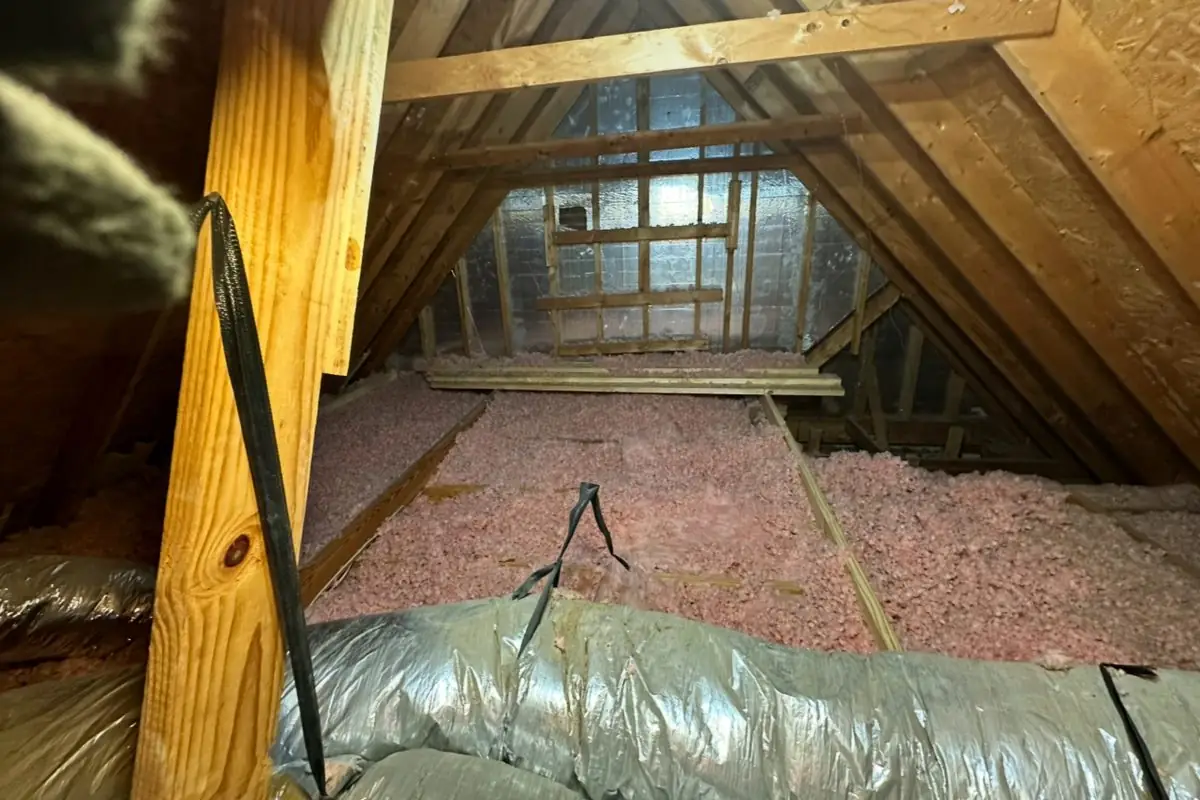
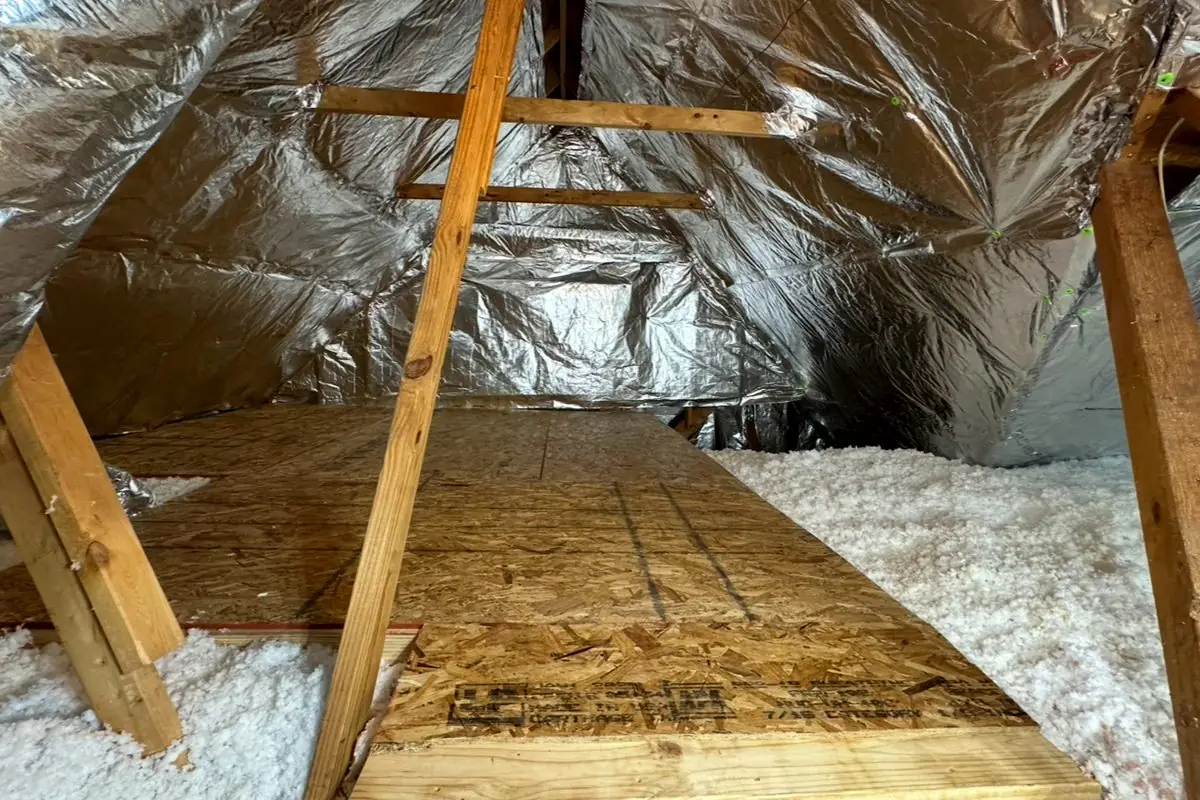 BeforeAfter
A real Houston attic, before and after. More photos →
Estimate guaranteed in writing
for a full calendar year.
A hose runs from a machine on the truck, up through the attic access, and into your attic. The crew walks the joists and feeds material through the hose by hand, filling evenly and checking depth as they go rather than eyeballing it once at the end.
That's the advantage over rolled batts. Batts are cut sheets — trimmed and pieced around every pipe, wire, brace, and vent chute. A Houston attic full of recessed lights, HVAC ducting, and truss framing rarely offers a clean rectangle to fill. Blow-in fills the whole plane regardless of what's in the way.
Two materials dominate blow-in work: fiberglass and cellulose, which is recycled paper treated with a fire retardant. Both fill obstructed spaces well when installed correctly. Where they differ is what happens after install day.
Cellulose is paper, and paper absorbs moisture. Houston carries humidity most of the year, and wet cellulose compacts, loses loft, and can hold dampness against the roof deck. Fiberglass doesn't absorb water, so it holds its shape and doesn't give mold anything to work with. Cellulose is also denser and settles further over time, so the depth you start with isn't the depth you keep. Given Houston's climate, we install fiberglass attic insulation on every job, not cellulose — it's the material that keeps performing after the truck leaves.
You don't need us up there to get a sense of where you stand. Grab a flashlight and look across the joists.
Stand a ruler on end at a few spots for a rough read on depth. If any of this sounds like your attic, the free assessment gives you real numbers — we measure it, photograph it, and show you exactly what's there.
Not every job is a straightforward top-up. Attic insulation removal comes first when:
Removal means vacuuming the old material out, containing dust as it comes down, and making sure the space is clean and dry before anything new goes in. Skipping it when it's needed just buries the problem under a fresh layer. More on attic insulation removal.
A typical install runs about one day. We tarp the access path, protect flooring along the way, and seal off registers and fixtures near the work area so dust stays where it belongs. The hose runs from the truck to the attic, and the crew works the material level and even, checking depth as they go rather than eyeballing it at the end.
When it's done, the workspace gets vacuumed out and the crew leaves with the debris, not you. We photograph the attic before and after on every job, so you have a record of what changed. Browse before & after photos from Houston attics we've done.
Insulation resists conduction and convection: the slow, steady heat that moves through material and air. It cannot reflect the radiant heat pouring straight off a sun-baked Houston roof deck — that's a different mechanism, and it needs a different fix. A Sol-R-Shield reflective insulation layer handles the radiant side. Most Houston attics we see benefit from both, which is why we call the combination our Total Attic Solution. Fixing only one side of the problem leaves the other one on the table.
Once we've measured your attic and written up a quote, that number doesn't move. A quote from July is still good in December — no re-inspection, no "prices went up" conversation. Insulation usually isn't an emergency purchase, so we built the quote to survive whatever timeline you're actually working with.
Look across the joists with a flashlight. If you can see the tops of the wood framing over any real stretch, insulation is running low — most Houston attics we open are well below where they should be. Flat patches, uneven depth, and daylight through the roof boards are all signs. The free assessment gives you exact numbers instead of a guess.
We install fiberglass. It doesn't absorb moisture the way cellulose does, so it holds its shape in Houston's humidity.
It depends on your attic's size, how much insulation is already up there, and whether old material needs removal first. We measure all of that at the free assessment and hand you a written quote on the spot — locked for a full 12 months.
Not always. Dry, clean, reasonably even insulation can usually just be topped up. Removal comes first when there's rodent contamination, water or mold damage, or settling so heavy it won't fix with a top-up. We'll tell you plainly at the assessment if your attic needs it.
About one day for a typical Houston home. We tarp the access path, seal off nearby registers and fixtures, run the hose from the truck to the attic, and vacuum out the workspace when we're done.
They solve different problems. Insulation slows conduction and convection; it can't stop radiant heat off a hot roof deck, which takes a reflective layer like Sol-R-Shield. Most Houston homes benefit from both — our Total Attic Solution. The free assessment tells you where you stand on each.
Find out in an hour, free — with photos of your own attic and a written quote locked for a full 12 months.
 Stone