Radiant barrier or more insulation? The two are easy to mix up. The answer starts with one idea: heat moves in more than one way, and each product stops a different kind.
Estimate guaranteed in writing
for a full calendar year.
Think about a hot stove. Touch the pan and heat moves into your hand. That is conduction: heat moving through something solid. Warm air rising off the pan is convection: heat carried by moving air.
Now hold your hand near the pan without touching it. You still feel the warmth. That is radiant heat. It travels in straight lines through open space, like sunlight.
Attic insulation is made to slow conduction and convection. Its strength is measured as R-value. The higher the number, the harder it is for heat to move through. A radiant barrier is made for the third kind of heat. It is a foil layer that reflects radiant heat instead of soaking it up.
Houston is hot, humid and sunny. U.S. Department of Energy county listings place Harris County in IECC climate zone 2A, a hot-humid zone. In summer the sun heats the roof, and the roof sends that heat into the attic. Houston attics reach ~140°F in summer.
From there, the heat tries to work its way down through the attic floor and into your rooms. A radiant barrier works on the first step, the heat coming off the roof. Insulation works on the second step, the heat moving down through the floor.
The Department of Energy says that in hot-humid climates, a radiant barrier in a vented attic may make sense alongside insulation. And independent TVA testing shows radiant barriers cut heat transfer 16–40%.
Insulation is the base layer. Without enough depth, heat passes through the attic floor with little to slow it down. For retrofitting existing homes in climate zone 2, ENERGY STAR lists R-49 for an uninsulated attic and R-38 if you already have about 3–4 inches. Those are guide levels, not a promise about any one home.
Here is a quick check. Look across your attic floor with a flashlight. If you can easily see the floor joists, the insulation is level with or below them, and ENERGY STAR says to add more. If it covers the joists evenly, you probably have enough depth. Check the corners and edges too, since coverage should be even.
What insulation can't do is reflect. A thick layer can slow heat on its way into your rooms, but it does not bounce radiant heat back toward the roof.
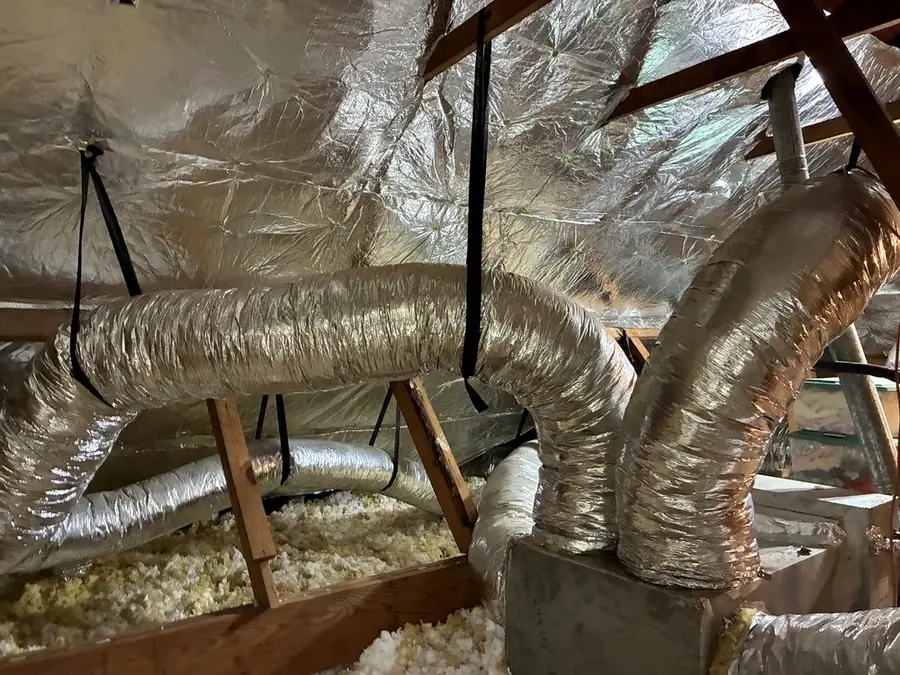
Our radiant barrier is Sol-R-Shield™ reflective insulation, a foil layer that reflects up to 97% of radiant heat. It goes up under the roof, on the rafters, with open air next to the foil. The foil needs that air space to do its job.
Placement matters. The Department of Energy says a radiant barrier should not touch the insulation on the attic floor, because moisture can get trapped under it. That is why it goes at the roofline, not on the floor.
What it can't do is add R-value. If your attic floor is short on depth, foil on the roof will not fix that.
Use this as a starting point. Every attic is different.
Not sure which one describes your attic? That is normal. It is hard to tell from the hatch, and that is what the assessment is for.
We photograph what we find so you can see it too. Then you get a straight answer: radiant barrier, insulation, both, or neither.
The visit is free and there is no obligation. You get a written quote guaranteed for 12 months. Our in-house crews do the work, with no subcontractors. We are Houston-based, with 5.0 stars from 74 Google reviews. See how we work as an attic insulation contractor in Houston.
Not quite. A radiant barrier is sometimes called reflective insulation, but it works in a different way. Regular insulation resists heat moving through it, and R-value measures that. A radiant barrier reflects radiant heat. According to the U.S. Department of Energy, it does not add R-value.
No. Because it does not add R-value, it cannot make up for thin insulation on the attic floor. The two do different jobs and work together.
Look at your attic floor from the hatch with a flashlight. ENERGY STAR says that if the insulation is level with or below the floor joists, you should add more. If it covers the joists evenly, you probably have enough depth. A free attic assessment measures it for you.
Maybe. Thick insulation slows heat moving down through the attic floor, but it does not reflect radiant heat coming off the roof. Whether a radiant barrier adds anything depends on your attic: what is up there now, how hot it gets, and what is in the way. That is what we check at the assessment.
Under the roof, fastened to the rafters, with an air space next to the foil. It should not lie directly on top of the insulation on the attic floor. The U.S. Department of Energy warns that installing it that way can trap moisture.
The R-value levels are guide numbers for typical homes. They are not a promise about any one attic.
A free attic assessment gives you a straight answer, with photos of your own attic and a written quote guaranteed for 12 months.
 Stone
Stone